- The Cognitive Dissonance Dispatch
- Posts
- Reconsidering Empire of the Sun
Reconsidering Empire of the Sun
A new appreciation of Spielberg's forgotten masterpiece.

Jack Davis
May 07, 2026
Longtime readers will know that I occasionally delve into movie reviews and cinema topics, as evidenced by my posts on the work of David Lean and Stanley Kubrick.
Today I take on Steven Spielberg, or at least one of his creations - Empire of the Sun (1987). It is, without understatement, one of Spielberg’s most overlooked films. When I saw it in the theatre I came away with mixed feelings…not sure how it fit into my world view.
Growing up, I wanted to be Steven Spielberg. I wanted to be a filmmaker and tell amazing visual stories like he did. His repertoire (along with George Lucas) steered my consciousness more than is healthy. Films like Jaws, Raiders of the Lost Ark, Close Encounters of the Third Kind, E.T., and even 1941 shaped my childhood irreversibly.
I grew up going to an Episcopal Church. I bet Steven Spielberg had a bigger influence on me. It was (and is) a spiritual relationship.
But Empire of the Sun was always a bit of an outlier. I was 16 when it came out. I knew I was seeing something special but was uncertain as to exactly what.
So earlier this year I re-watched Empire. And it shocked me with its genius. It truly is a masterpiece, and has messages and themes that resonate today like a gut-punch. Perhaps I needed to be older. Maybe I needed to reset my expectations. But Empire of the Sun should be on every cinephile’s required viewing list.
Today I’ll dig into some of the ways this movie impacted me, and share some of my thoughts on why it is such a powerful story, especially today.
»»»»»»»»»»»»»»»»»»
Note: I am not going to rehash the plot in detail. Hopefully you have seen it, or will go catch-up. It’s currently freely available on Youtube, click here: Empire of the Sun. If nothing else, you can find a quick summary here.
But in brief - the movie is the tale of Jamie Graham, a privileged English boy living with his family in Shanghai. When World War II breaks out, he loses his parents and undergoes a series of adventures culminating in a Japanese refugee camp.
Please take an evening and give it a full viewing, then come back to this post to see if my perceptions align with yours…
»»»»»»»»»»»»»»»»»»
I’ll dig into my thoughts across a number of themes and subjects, so let’s begin:
Cinematography
Even when I saw the film for the first time, I recognized that it contains some of the most amazing images ever put to film. The sheer spectacle, grandeur, and photographic composition (underscored by the deeply moving soundtrack and the traditional Welsh lullaby Suo Gan) seers into your brain like a X-ray tattoo. I could list a dozen scenes that visually leave you breathless - but I would do them scant justice.
Put simply, is a smorgasbord for the eyeballs, and how Spielberg managed to stage those scenes seems miraculous.

Just one of the unforgettable images from Empire of the Sun.
The Loss of Empires
The setting for the movie is in occupied China, but the overlapping ebbs and flows of empires provides the context. Of course, China’s glory days are long gone, as evidenced by its subsidiary status at the outset of World War II. The real actors on the stage are the British and Japanese. One empire stubbornly refusing to recognize its sunset after centuries of global rule, the other a recent flash of dominance, now at risk of ruin. Scene after scene highlight the tenuous nature of each…proud British citizens trying to maintain their order of place in the chaos of war. The Japanese faced with extinction as their momentum stalls and the tide turns. Who can adapt fastest will survive…bringing another theme into relief.
And over the horizon, rarely seen but always sensed, the Americans are coming. Perhaps a new empire is on the rise…for a time.
But the loss of greatness and pain of servitude echo throughout the film. How hard it must be to watch the strength and fortitude of a society drain away, hit the wall, and self destruct through pride and overconfidence.
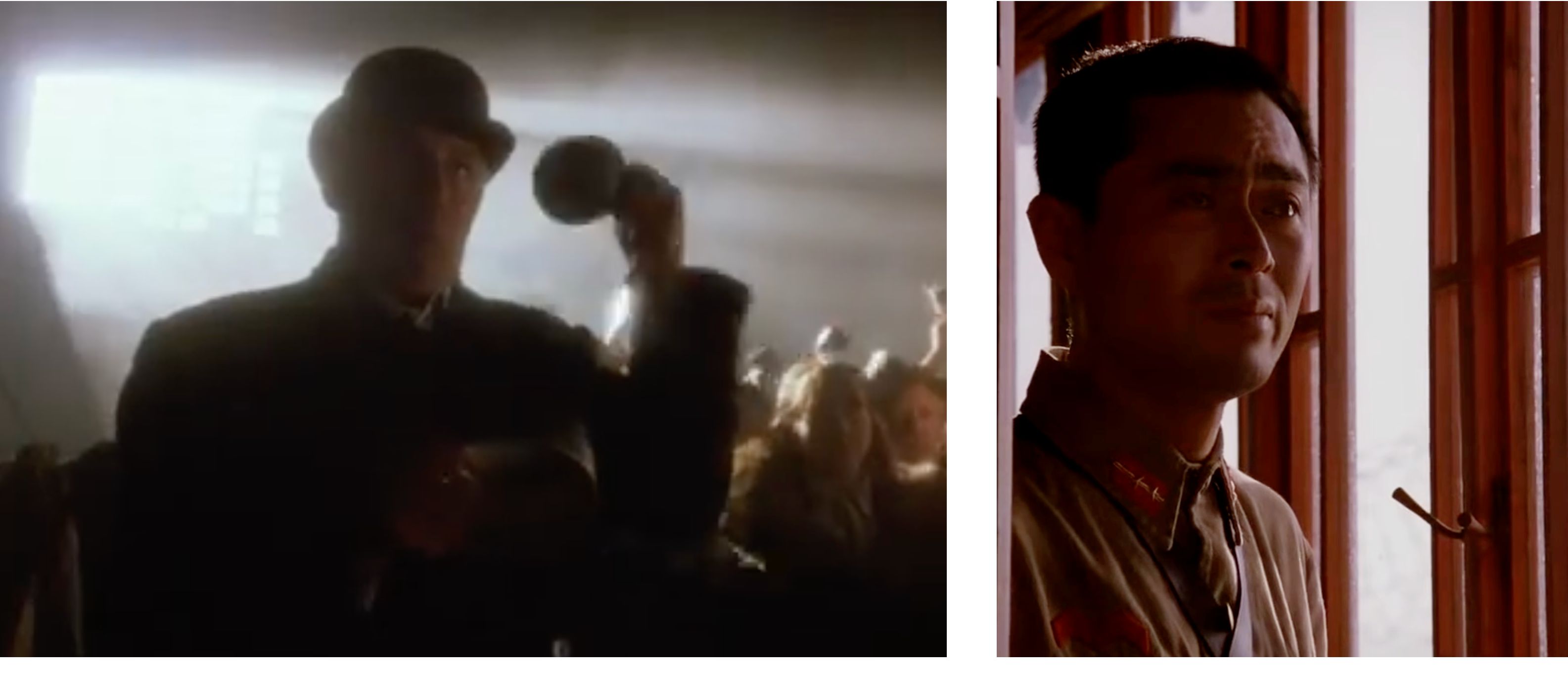
Both British and Japanese Empires fail to survive the conflict.
The Search for Family
The movie kicks into gear when Jamie, or “Jim” as the Americans brand him, loses his family and gets carried through the turbulent tides of occupied Shanghai. Jamie initially treats the events as a lark or adventure. But hunger and loneliness cause him to venture out into the war torn city. There, he meets Basie, the American bandit focused on nothing but survival, who becomes one of many surrogate father figures to Jamie. Jamie bounces around from guardian to guardian, learning and adapting from each. The British couple, Dr. Rawlins, Basie and the Americans. Even the Japanese seem to adopt Jamie as part of their tribe.
But throughout Jamie can’t fill the hole left by losing his family. He memorably states at one point “I can’t remember what my mother looks like.”
It’s the through-line of Jamie’s journey - testing and learning different family models, different moral codes, and different definitions of love.
But at some point he will have to choose. As we will see.
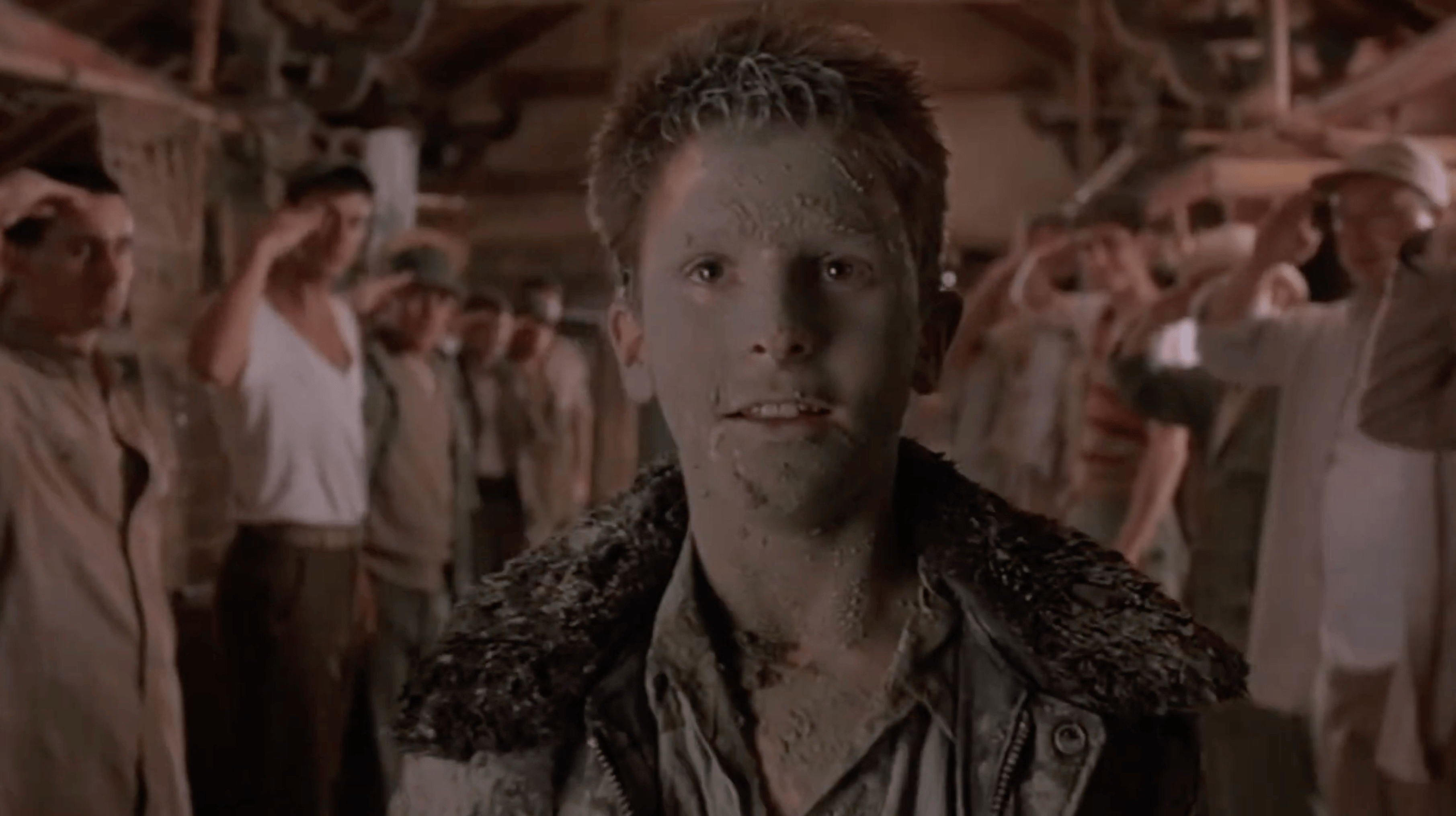
Jamie earns a place with the Americans, a surrogate family.
From the beginning of the film we are shown Jamie’s passion for airplanes…he loves them more than anything. His model planes, toys, and encyclopedic knowledge of flying provides him with joy.
When in the refugee camp Jamie encounters a Japanese boy with the same passion. Their shared love of flying crosses cultural, societal, and political boundaries, bonding the two together. They develop a distant, yet powerful relationship grounded in a common interest.
Eventually, they briefly get to connect and laugh together as the war winds down. But tragedy strikes, as Jamie’s friend gets killed by prejudiced fools in a flurry of greed and ignorance.
It’s utterly heartbreaking, yet points to a better path. It shows how we can form connections with anybody…and perhaps avoid all these conflicts in the first place - if we simply recognize our similarities versus focus on our differences.
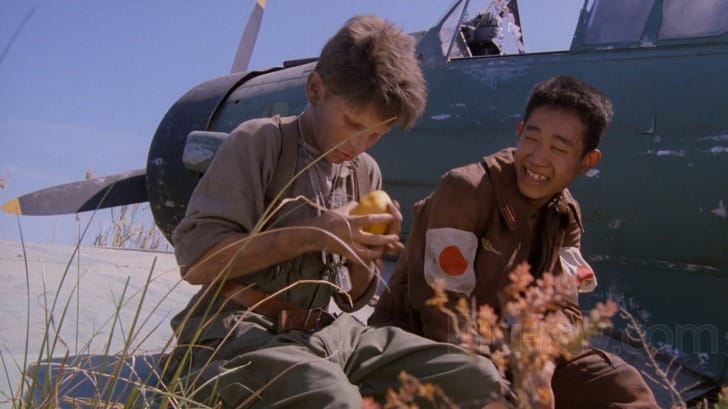
A brief connection, rooted in shared interests.
Jamie gets rescued and adopted by Basie and his crew at a critical time - and he immediately becomes infatuated with their vibe. Loud, confident, full of swagger and swindle - Basie’s gang is always on the lookout for the next score, the next prank, and the next getaway. Over the course of the film, Jamie eventually learns that they are also cutthroat, greedy, disloyal, and not to be counted on. They are in it for themselves, and no other.
This is contrasted with the distant presence of another America. The American army, backed by a nation full of resources. Evidenced most directly by the airplanes that attack the Japanese base - especially in one of the most compelling sequences of the film, the P-51 Mustang, the “Cadillac of the Sky” - but also by the squared jawed, clean cut, and ridiculously handsome soldiers that save Jamie at the film’s end. This America is technically proficient, eminently capable, selfless, and morally centered.
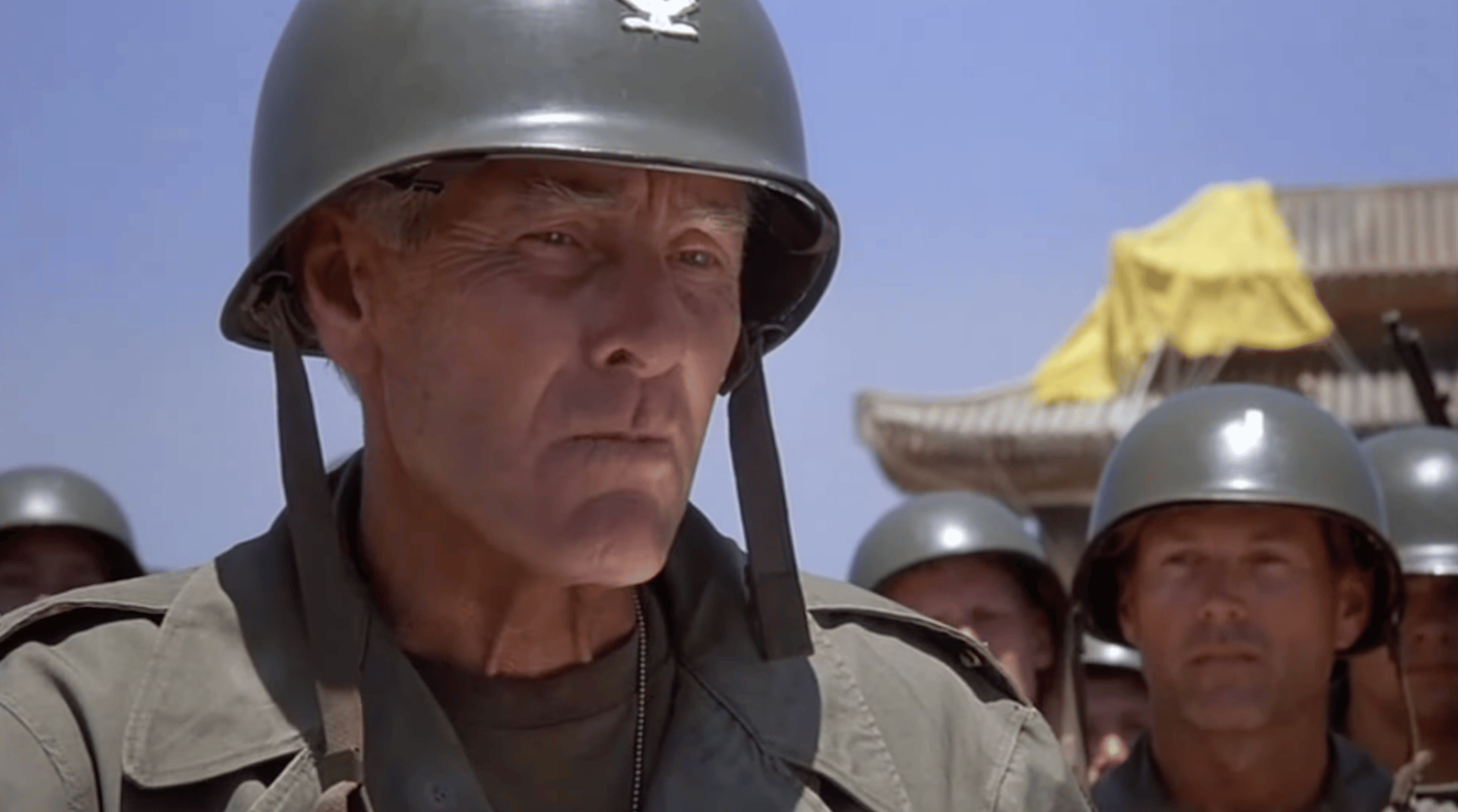
The idealistic America.
Jamie is torn throughout the film by these two models. Survival or idealism? Swagger or skill? In the end, he rejects Basie’s zero-sum game philosophy, screaming at him “You taught me that people will do anything for a potato!” - throwing the horror of survival back into his face. Jamie ends up choosing the idealistic America, even though Basie helped him survive again and again.
It must be said that Christian Bale, the actor who plays Jamie, deserved an Oscar for this performance. Say whatever you want about Christian as a performer, few movie stars can convey such contempt and rejection through their eyes as he does at the film’s climax. He was 13 at the time of making the film.

Jamie’s hatred of Basie and all he stands for, wordlessly and devastatingly expressed.
Materialism versus what really matters
The last theme - and perhaps the most powerful - is that of our relationship to our “stuff.” For the majority of the story, survival is equated with who has the most stuff. Jamie initially gets the favor of Basie by promising “Rich pickin’s” in terms of things to steal. Empire of the Sun continuously shows the connection of people to things - much to their detriment. When Basie gets beaten by the Japanese soldiers and taken away, he commands to Jamie “You’re in charge of my stuff!” People are constantly trading in the camp, trying to accumulate the right stuff. Suitcases are a visual metaphor used throughout, people carrying their stuff.
This comes to a climax at the scenes at Nantao Stadium - where all of the British possessions have been accumulated and the refugees are reunited with their things in a perverse way. Some simply collapse and die on the spot, seemingly happy to be there, reconnected with their things. Others wander aimlessly, confused. It’s a surreal moment, punctuated by the flash of the Atomic bomb - connecting our love of things with devastating destruction.
But not Jamie. He had already made his decision. On the journey from the refugee camp he stopped and threw his suitcase into a nearby estuary. All his possessions, all his stuff, did not matter any more. His entire world had been in that suitcase, but at the end he recognized it was simply stuff. It wasn’t what mattered.
The last two scenes of the film punctuate this view. Jamie is reunited with his parents and seems to finally recognize (and remember) his mother’s face. He is returned to what is important - his family.
The final shot echoes the very first. At the beginning of the film, the camera pans across coffins floating in the Shanghai bay, bumped aside by a naval ship. The last shot is a visual echo, of Jamie’s suitcase floating in the waters, just like the coffins. The point couldn’t be more clear. Stuff equals death.
It’s the people in our lives that matter - and the moral codes we choose to live by. Empire of the Sun is a classic story for all times…how to survive horrible times without losing your soul.
It’s told beautifully, visually, and pointedly. It’s a film worth watching every couple of years.
Lest we forget its lessons.
Parting Proclamation
Words, wit, and wisdom.
A house is just a place to keep your stuff while you go out and get more stuff.
Enjoying The CD Dispatch?
Please share, forward, retweet, repost, like, publish, proselytize, subscribe, praise, promote, and generally make it clear to your friends and colleagues that life is simply not worth living unless you’re a subscriber.
Why should you have all the fun?
No, seriously. Who do you think you are? Selfish bastard…
Disclaimer:
All content and opinions are solely those of the author (Jack), and not representative of my employer, former employers, clients, anyone in Congress, my family, former college roommates, Baptists, the good citizens of Oregon and Colorado, or my dog Mabel.